
Emotion and reaction changes everything
For thirty-five years, I taught people how to fight—and how to stop reacting emotionally under pressure.
Not movie fighting. Not tough guy fighting. Real training built around one principle: the person who reacts emotionally usually loses.
A fighter who gets angry swings too wide. Moves too fast. Misses what is actually happening. The goal was never to eliminate emotion. The goal was to train a response that was stronger than the emotion—and that’s the first step in learning how to stop reacting emotionally.
What surprised me over the years is that the exact same principle applies outside the gym.
Most of us have never been taught how to handle conflict in conversation. We know how to talk, but we haven’t been trained how to respond when we’re frustrated, criticized, disrespected, or emotionally triggered. So, we do what untrained fighters do: we react emotionally.
Someone raises their voice, and we raise ours. Someone criticizes us, and we counterattack. Someone pushes, and we push back.
After years of teaching physical combat, I’ve come to believe that conversation is simply another arena where training matters. The same skills that help fighters stay composed under pressure can help ordinary people stop reacting emotionally and start responding intentionally.
And it all comes down to a beat so small most people never notice it’s there.
The Beat You Don’t See
Slow the push down. Watch it frame by frame.
Person one pushes. Person two recognizes the push — registers it, feels it land. Then comes the anger. Then comes the shove back.
There’s a beat in there. A real one. Recognition, then anger, then reaction. It happens so fast it feels like one motion, like there’s no space between getting pushed and pushing back. But there is. That tiny beat is where this entire article lives, because everything that goes wrong — everything — goes wrong in that beat. Learning how to stop reacting emotionally begins by recognizing that tiny beat between feeling and reacting.
This isn’t a character flaw, by the way. Your brain is built to feel before it thinks. The emotional signal reaches you a fraction of a second before the reasoning does — psychologist Daniel Goleman called it the “amygdala hijack,” the moment feeling grabs the wheel before logic can get to the front seat. The anger genuinely arrives first. Every time. That’s not weakness. That’s just being a person. The question is never whether you’ll feel the spike. The question is what you do in the beat that follows it.
Now Take the Hands Out of It
The push matters because it’s the same thing that happens in conversation, except in conversation you can’t see it.
“I asked you three times to do the dishes. Why don’t you ever do them when I ask?”
Recognition. Anger. And out it comes: “Well, you never take out the trash.”
Same three beats. Same equal-and-opposite reflex. The only difference is that nobody’s hands moved, so it doesn’t look like a shove. But that’s exactly what it is. And if you step back and watch it the way you’d watch two strangers shoving in a parking lot, you notice something ridiculous: what does the trash have to do with the dishes? Nothing. They have nothing to do with each other. You didn’t mention the trash because it was relevant. You brought it up because you needed to push back, and the trash was the nearest thing to push with.
That’s the tell. The moment your response has nothing to do with the actual issue, you’re not solving anything. You’re matching energy.
The Two Thoughts — and the One We Grab
People don’t snap at you in a vacuum. Somebody might be overreacting — the heat might be coming in hotter than the situation deserves — but there’s almost always a real spark underneath. And when someone comes at you hot, two thoughts flash through your mind in the same instant:
Yeah… I didn’t do the dishes.
And: Why is this person so bent out of shape?
Both are true. But watch for which one you reach. We grab the second one. Every time. We lock onto the intensity of their reaction and quietly let ourselves off the hook for the thing that started it. Their yelling feels like an unprovoked action — an offense committed against us — when it’s actually a reaction to something we did. We edited ourselves out of the story, cast them as the aggressor, and now we get to feel justified matching their heat.
That’s the whole machine. We match intensity because focusing on how big their reaction is feels a lot better than admitting we earned a smaller version of it.
How to Stop Reacting Emotionally When Someone Else Is Angry

Say that sentence aloud and listen to how it sounds.
I’m angry because they’re angry.
Sit with the ridiculousness of it. They raised their voice, so now you’re raising yours. Their emotional state reached over and set your emotional state. You’ve handed them the lever. Their choice to come in hot is now controlling how you respond. Unless you enjoy being angry, why would you give someone else that kind of control over your own internal weather? If you’ve ever wondered how to stop reacting emotionally during an argument, this is where it begins.
And telling someone who’s intense to stop being intense does not work. “Don’t talk to me that way” in the middle of someone’s flare-up is gasoline, not water. When a person is lit up, you don’t cure the intensity by demanding they drop it. You lower the temperature first, and then you have the conversation. That’s not modern psychology. That’s wisdom that’s been around as long as people have been arguing.
I Still Fall Into Reacting Emotionally
I’ve spent my life training in combat, and I still don’t have this handled. I don’t feel the push coming, name it, and calmly step aside every time. Not even close.
Matching intensity is the most natural thing in the world. It isn’t even just human — it’s animal. Watch two dogs square up sometime. One escalates, the other escalates to match, neither of them decided anything. That’s the wiring we’re all running on. The training doesn’t delete it. What the training gives me is the habit of asking a question in that beat — hold on, I think I’m matching intensity here… what’s going on? And because I’ve drilled it, I often catch it fast: this is going to scale into a fight if I don’t actively do something. Responding instead of reacting is a skill, not a personality trait.
Often. Not always. Because asking that question is an active process — you must do it, every single time, against a current that’s pulling the other way. And there are still plenty of times, including in recent memory, where I don’t ask it. Where I let the intensity run amok and realize, a few exchanges too late, that I’m now stuck in the quicksand right alongside the other person. Same mud. Same struggle. I helped put us both there.
So, I’m not writing this from above it. I’m writing it from inside it, same as you. The difference a little training makes isn’t that you stop feeling the pull. It’s that you catch yourself more often — and “more often” turns out to be worth an enormous amount.
The Difference Between Adding Wood and Putting It Out
Real fights almost never jump straight from words to fists. They climb. A tap becomes a shove, a shove becomes a punch, a punch becomes two people locked up trying to land something worse. Especially with untrained people, the escalation is gradual — each person adds a little more heat than they just received, and up the ladder it goes.
It’s a fire. Somebody drops the first piece of kindling, the other person adds a piece, and if you keep feeding it heat for heat, eventually you don’t have kindling anymore. You have a blaze, and a blaze burns everything around it — including the things you cared about.
A trained fighter does something different at the first spark. They make a decision. Is this fight worth having? Is there real danger here? If the answer is yes — genuine threat — then you don’t escalate gradually. You end it decisively and you end it in your favor. Slow burning a real danger is how you get hurt. But almost every conflict you’ll have in your actual life runs the other way: the answer is no. There’s no real danger. It’s the dishes. And when the answer is no, you don’t keep the fire on a polite low simmer. You put it out.
What Putting It Out Actually Sounds Like
So how do you put it out? You go back and react to the right thing.
The spark was real — you said you’d do the dishes, and you hadn’t. So, you acknowledge that, instead of swinging at the trash. It sounds something like this:
“You’re right. I should have done them, and honestly, I should have told you I was planning to do it at halftime instead of leaving you guessing. I’m sorry I upset you — I did say I’d handle it. Is it okay if I finish this quarter and get to it during the break?”
You didn’t match the intensity. You didn’t dig up an unrelated grievance. You gut-checked the actual facts — is it true I didn’t do them? Yeah. Is it true they asked? Yeah — and you responded to those facts instead of to the volume. You acknowledged your piece of the spark. You didn’t roll over and you didn’t pretend you had no part in it. You just took the fight off the table by refusing to feed it.
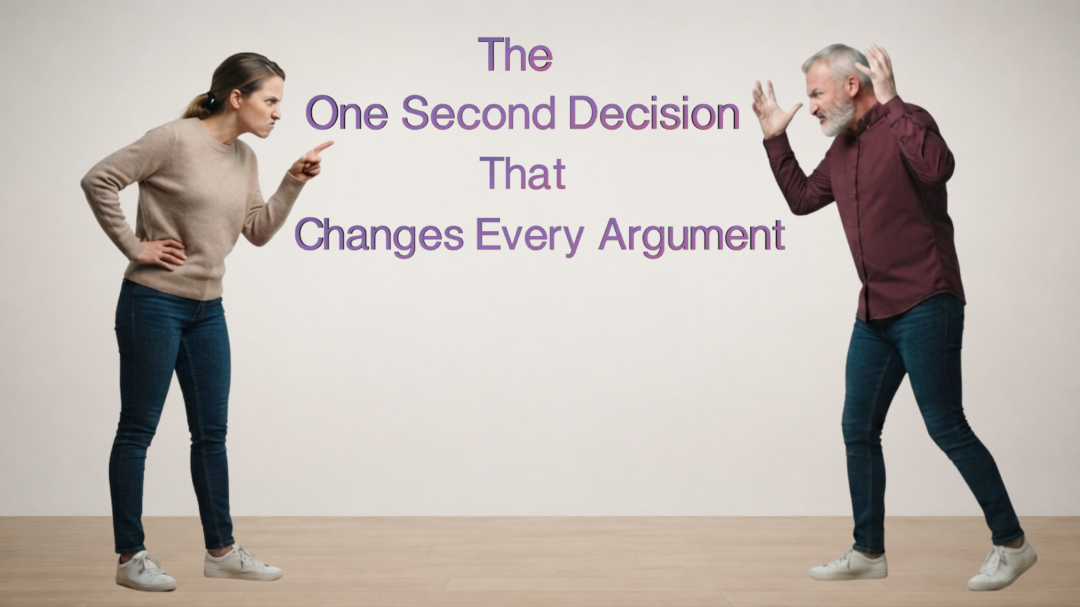
That’s the one-second decision. Not counting to ten. Not white-knuckling your way to fake calm. Just one beat—long enough to ask, “What’s actually going on here? Am I about to match heat that I helped create?”—before you let the reaction fire. Learning how to stop reacting emotionally isn’t about suppressing your feelings. It’s about creating enough space to choose your response instead of your impulse.
It feels, at first, like you’re losing something by not pushing back. You’re not. You’re keeping the one thing that was actually yours to begin with: the ability to deal with the real issue instead of the noise around it. The pause doesn’t make you a pushover. It routes you straight back to what mattered.
Now you’re reacting to the right thing. So, where do you go from here?
If this resonated with you and you want to learn how to release emotional weight, you might also find these useful:

Believing Through Achieving- Not the Other Way Around — the origin story behind the site and the philosophy that runs through everything I write.

Why You’re Still Carrying That Conversation — Even if you stop reacting emotionally today, old conversations can still shape tomorrow. Learn why—and how to let them go.
Research Citation: Langer, E. J., Blank, A., & Chanowitz, B. (1978). The mindlessness of ostensibly thoughtful action: The role of “placebic” information in interpersonal interaction. Journal of Personality and Social Psychology, 36(6), 635–642.