
What COVID Broke
Before the nonprofit existed, there were studios. A handful of us — senior instructors — had been working together and teaching together across Utah, Nevada, and California for years. They’re still my students. They also happen to be high-ranking black belts in their own right — people who started with me decades earlier and stayed, first as students, then as colleagues, then as teachers of their own students. That’s how martial arts lineage works. You never stop being somebody’s student.
What we were doing most of the time wasn’t really self-defense, even though that’s what the sign on the door said. It was confidence therapy. Life-skills therapy. For the kids on the spectrum, sensory-integration therapy. We weren’t licensed clinicians, and that distinction matters — I’ve always been careful about it. But therapists referred their clients to us because they saw what was happening in our rooms. Kids on the autism spectrum. Adults in recovery. Survivors of domestic violence. Kids getting bullied. Families in Boyle Heights and other neighborhoods where confidence isn’t something anyone has time to cultivate gently.
Each of us had a focus. I worked primarily with people on the spectrum. Bob worked with survivors of domestic violence and with foster families. Jeff worked with bullying victims and ran women’s self-defense programs. We weren’t specialists in the siloed sense — we all worked with all of it — but if you asked any one of us where our heart was, we’d each give a different answer.
Then COVID happened.
The studios closed. We tried Zoom, like everyone else. Watching it fail was its own kind of hard. A kid on the spectrum doesn’t learn in his own living room the way he learns in a room you’ve built for him. The whole point of the dojo for sensory-integration work is that the instructor controls the environment — the sound, the light, the pressure, the proximity — and calibrates it in real time to what the student can handle that day. In a Zoom call, the student is in his own environment. You can’t customize anything. The thing that was working wasn’t the content. It was the room.
We watched people regress. Kids we’d spent months building up lost ground in weeks. Parents who’d started to see their child emerge were watching him retreat. And we started having conversations about what to do.
Bring the Therapy to the Person
We didn’t want to rebuild what we’d lost. We wanted to build something that could reach people the old model couldn’t.
Five of us sat with the problem together — me, Bob, Jeff, Andy, and another guy also named Josh. Bob floated the idea of making it a nonprofit. Andy had the software background to actually build something. Josh had a creative background and understood everything about how a student experiences the process. We worked on it together over months.
The idea we landed on was simple to say and hard to execute: bring the therapy to the person. Build a system — curriculum, video, tracking, ranking — that could teach interested people how to deliver martial-arts-based life-skills training directly to the populations they were already working with. Occupational therapists. Psychologists. Physical therapists. Coaches. Parents. Community leaders in underserved areas. A kid in Boyle Heights shouldn’t have to find us. We should be able to reach him through someone he already trusts.
That’s what the nonprofit was for. That’s what it’s still for.
The Name on the Table
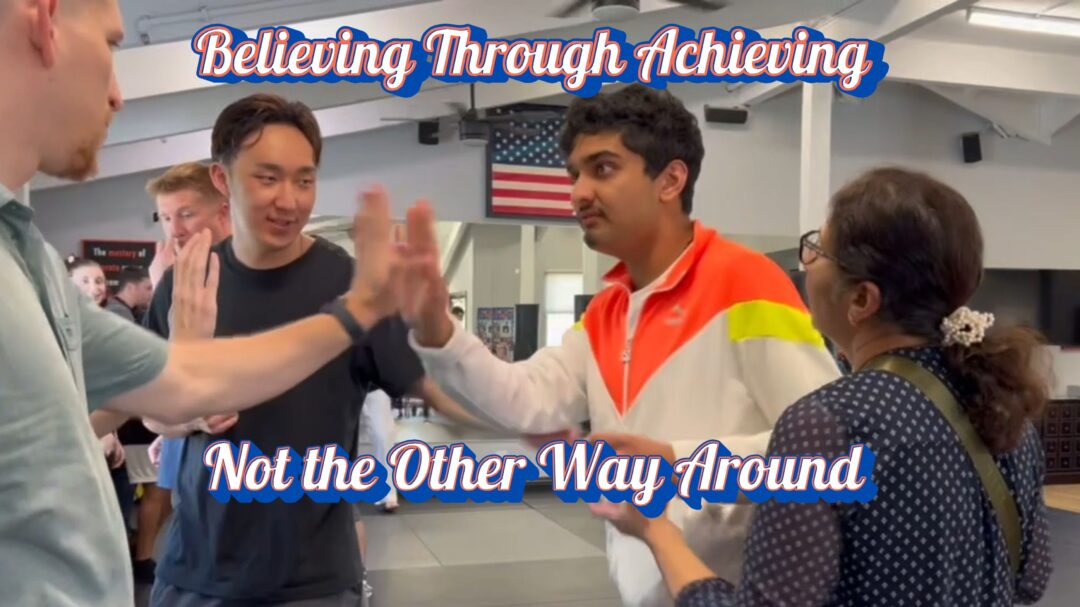
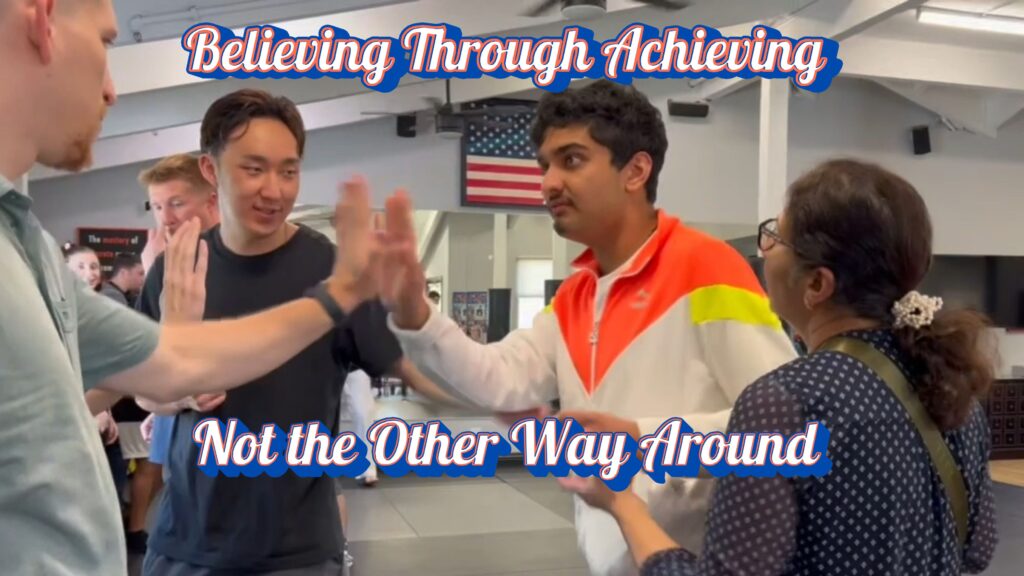
The name came out of a conversation I kept having with myself. I’d written down both versions — Believing Through Achieving and Achieving Through Believing — and sat with them. The team weighed in. The counterargument came up: shouldn’t belief come first? You have to believe you can do something before you can do it, right? That’s what everybody says. That’s what most self-help books say. That’s what every poster in every elementary school gym says: believe in yourself.
I’d watched it fail. Hundreds of times. In front of me. On a mat.
You can’t tell a kid to believe in himself. You can tell him all day. He’ll nod. His parents will nod. Everyone will feel better about the conversation. And nothing will change. Because belief you’ve been talked into has no foundation. There’s nothing underneath it.
What I’d watched — what every instructor on that team had watched — was something else entirely. Belief didn’t arrive because somebody told it to arrive. Belief arrived because somebody did something they didn’t know they could do, and then stood there holding the proof of it.
Where Belief Actually Comes From
Self-esteem is the belief that you’re somebody worth being. That you matter. That your existence has value. Self-confidence is the belief that you can do what you’re trying to do. That when you step up to the thing in front of you, you have a chance.

Those are two different kinds of belief. One produces the other. Self-confidence — earned through real, accumulated action — is the ladder you climb up to self-esteem. You don’t walk into self-esteem. You build it, one achievement at a time, until one day you’re standing on enough of them that you believe you’re worth standing there.
The metaphor I’ve used with my instructors for years is exactly that — a ladder. The top of the ladder is wherever the student needs to go. Emotional regulation. Physical coordination. Social confidence. A belt. A skill. A life. The question isn’t whether the student can get to the top. The question is whether somebody has built the rungs close enough together that he can take the next step without falling.
Anyone can climb the ladder if you add enough rungs.
That’s the thesis I’ve been carrying around for thirty-five years. Every instructor on that team carries it around too. The kid in front of you isn’t the problem. The rungs are the problem. If he can’t climb, it’s because the rungs aren’t where they need to be — not because he can’t climb.
The way belief starts is small. A victory the student didn’t know was a victory. Standing still for ten seconds when last week he couldn’t do five. Walking backwards without falling. Keeping his wrists straight on a pad for the first time. Something just small enough that he actually did it, and just big enough that he couldn’t have done it last week. That first victory is a spark. A small fire. As instructors, we breathe on it. We notice it. We name it. We put it where he can see it. The fire grows. And then we add a slightly harder rung — not too far, never too far — and he reaches for it. And if we’ve done the math right, he gets there. And the fire grows again.
The psychologist Albert Bandura spent decades researching this exact pattern. He called the phenomenon self-efficacy — belief in your own capability — and he found, across dozens of studies, that the most powerful source of it was what he named mastery experiences. The stubborn, boring accumulation of times you tried something and pulled it off. Nothing else came close. Not encouragement. Not affirmation. Not visualization. The doing was the source.
That’s what we were watching every week. That’s what we named.
You start with the achieving. The believing follows. And once it starts, it becomes the fuel for the next achievement, which feeds the next belief, which makes the next achievement possible. A virtuous circle that runs on its own momentum, once the first rung is placed somewhere the student can actually reach.
That’s why the name is Believing Through Achieving. The achieving is the path. The believing is what grows along it.
Linus
Let me change his name for his protection — call him Linus. He was six or seven years old when his parents brought him to me. He was on the spectrum, and his family was out of options. Team sports had failed. Other activities had failed. He didn’t want to leave the house. Whenever his parents tried to take him somewhere new, he fought them. A therapist had suggested martial arts. The parents were skeptical but desperate. They’d come to the end of what they knew how to do.
The first lesson wasn’t really a lesson. I sat with Linus and had him listen to the sound of his own breathing. That was it. That was the whole introductory session. Most of what I did that afternoon, though, wasn’t for him. It was for his parents.
I told them to have some patience. I told them not to worry. I told them: we’ve got this.
I want to be honest about what that moment actually is. Parents of a kid who’s been struggling for years aren’t asking for a miracle. They’re asking for a roadmap. They want to know that somebody has been through this terrain before, that somebody knows where the footholds are, that there’s light somewhere at the other end of the tunnel they’ve been walking through alone. The first rung I placed for Linus wasn’t for Linus. It was for his parents. The rung was a roadmap to hope.
Then we started. Standing still. Walking backwards. Picking up one leg while touching a wall for balance. Keeping his wrists straight on light pads. Following two-step directions, then three-step directions. Regulating his emotions when a drill got frustrating — which, at his age and on the spectrum, happened constantly.
Each of those things was a rung. None of them looked like martial arts to a casual observer. But that’s because martial arts isn’t the thing people think it is. Martial arts is the ladder you build underneath whatever you’re actually teaching. For Linus, the thing we were actually teaching was that his body could do something his brain didn’t trust it to do. Every rung he cleared was evidence. And the evidence accumulated.
Three months in, so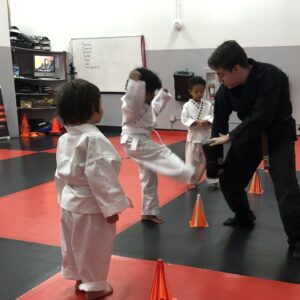 mething flipped.
Linus stopped fighting his parents about coming to the dojo.
Then he started fighting them about coming more often.
The kid who wouldn’t leave the house was now arguing with his family about wanting to spend more time in a room full of strangers doing hard things. Nobody had told him to believe in himself. Nobody had sat him down and said you’re special, you can do this. He had three months of accumulated evidence that he could do things he didn’t think he could do, and that evidence had done what no speech could have done. It had become belief.
When he finally earned his first belt, he wore it to bed. His parents had to put their foot down about him wearing it to school. He refused to let his mother wash it.
That belt wasn’t a piece of fabric. That belt was proof, in a form he could touch, that he had climbed a ladder he didn’t think he could climb. He didn’t want to take it off because belief, when it’s real and earned, is the most precious thing a kid has ever held.
What This Means for the Rest of Us
Everyone wants to believe in themselves a little more than they currently do. That’s universal. And most of us already believe in ourselves in certain areas. You might believe in yourself as a parent. You might believe in yourself at your job. You might not believe in yourself in any physical way, or any creative way, or any social way. That’s normal. Everybody has some areas and not others.
If you currently believe in yourself in four areas, there’s nothing wrong with having five. There’s everything right with having five. And if you currently believe in yourself in zero areas, it is especially important — not someday, not when you’re ready, but now — to start building one. Just one. Because one area of real, earned belief is what makes a second area possible. The fire has to start somewhere.
And the way to start it isn’t by talking yourself into it. It’s by finding one thing that’s genuinely a stretch and genuinely achievable, and doing it. Then doing it again. Then doing the next slightly harder version. The rungs aren’t far apart. They just have to be in the right order.
If you’re trying to build confidence in yourself, or in someone you love — a kid, a partner, a student, a parent — and you’ve been doing it by telling them they can, and hoping the belief will follow, it might be worth asking whether the ladder has enough rungs. Belief that’s been talked into existence is fragile. Belief that’s been earned one rung at a time is the kind that survives contact with the world.
The achieving comes first. The believing follows. And once it starts, it can carry a person further than anything anyone ever said to them.
That’s why I named the nonprofit what I named it. And that’s why I’ll never name it the other way around.