
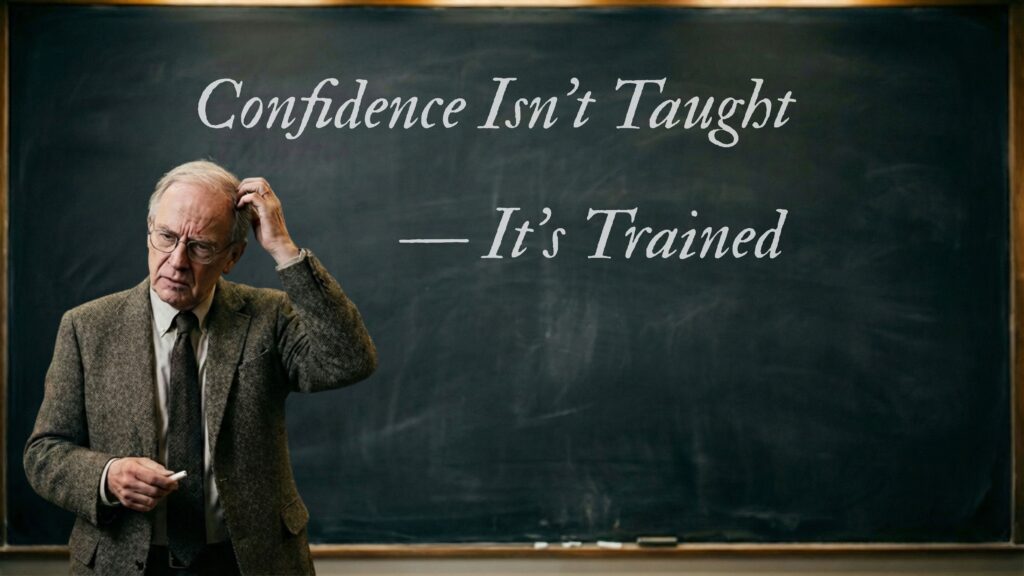
Structure builds confidence when students experience success through clear steps, consistent practice, and repeated progress.
– Part 1 of the Confidence Series
 Confidence isn’t something you teach.
And most systems trying to build it are quietly failing.
We tell students to be confident.
We encourage them.
We praise them.
But confidence doesn’t come from being told you can do something.
It comes from experiencing that you can.
And after 35+ years working with thousands of students—from neurodiverse learners to high-performing athletes—I’ve seen the same pattern again and again:
Confidence comes from competence.
And competence is built through structured repetition. Psychologist Albert Bandura described this kind of earned belief as self-efficacy: the confidence that grows when students experience themselves succeeding through effort and practice.
Structure builds confidence when students experience success through clear steps, consistent practice, and repeated progress.
The Misunderstanding About Student Confidence
Confidence is not a personality trait.
If you’re a parent, teacher, or therapist, you’ve seen this:
- A capable student hesitates
• An average student never gets the chance to realize their potential
• A struggling student disengages before they even begin
This isn’t a motivation problem.
It’s a structure problem.
When success feels unpredictable, students hesitate.
If it feels out of reach, they avoid trying.
When they can’t do something perfectly, they often don’t do it at all.
What looks like resistance is often uncertainty.
And uncertainty is a structural problem—not a character flaw.
A Student Who Made This Clear
In the early 90s, I had a student we’ll call Nathen.
He was eight years old. Nonverbal. Sensitive to light, sound, and the unpredictability strangers posed.
Before his first lesson, his mother, Kathy, called to explain his needs. We scheduled his sessions when the studio would be empty. I adjusted the lighting before he arrived.
When Nathen walked in for his first lesson, he was already wearing a white uniform. I had given it to his mom ahead of time. But I intentionally withheld the belt.
Not as a test, but as a way to create a clear starting point.
Before we stepped onto the mat, I said to him,
“This is your karate belt. You only wear it in your karate school. I will put it on for you—but you will learn to tie it yourself.”
Structure Creates Entry Points
Then I asked, “May I put your belt on now?”
He was holding his mom’s hand.
I wasn’t asking her.
I was asking him.
He looked at Kathy. She nodded.
Then he looked back at me, expressionless, but present.
That became a pattern.
Every time I asked him to do something, he looked to Kathy first.
She was his point of reference.
His authority.
I took that as permission.
As I tied his belt, he looked down and watched carefully.
I extended my hand, and we stepped toward the mat.
“In our school,” I said, “we bow when we step onto the mat. When you’re ready, you can do it too. Everything you will do here is by your choice.”
I bowed. He didn’t. But he followed me onto the mat.
We stood just a few feet inside, within view of Kathy.
I asked him to stand with his feet wide like mine.
He looked at Kathy. Then back at me.
He didn’t move.
I knelt down, pointed to the floor, and said, “Put this foot here.”
Still nothing.
So, I placed his hand on my shoulder and said, “Hold me for balance.”
Then I gently guided his foot into position.
He never broke expression.
“That’s it,” I said. “We’re ready for our first lesson.”
Authority Shapes Confidence
Then I asked Kathy to wait outside so we could begin the first lesson.
For the first time, Nathen reacted. He looked surprised.
Up to that point, she had been his authority. She was the boss and I just told her what to do and now she was stepping away.
And without saying it directly, that authority shifted.
Kathy stepped outside.
And Nathen stayed.
And with that shift came something new:
The possibility for independent action.
Confidence Begins With Structure, Not Success
For weeks, Nathen didn’t initiate movement on his own.
We worked on:
- One stance
- One circular arm motion practiced on both arms
- One repetition at a time
Progress was slow.
But it was consistent.
And consistency matters more than speed.
How Structure Success Builds Confidence
We don’t change the standard; we change the entry point. Meeting students where they are without lowering where they can go.
What made the difference wasn’t encouragement.
It was how the movement was structured.
The foundation of our training is what we call bilateral coordinative movement, the integration of right and left sides of the body, upper and lower movement patterns, and both circular and linear motion.
These are the building blocks behind every Skill Challenge.
We break every skill into layers:
- Tier 1 – Isolate
Single movements practiced independently - Tier 2 – Combine
Two movements linked together - Tier 3 – Integrate
The full skill broken into sections - The Challenge
The complete skill performed independently
With Nathen, we stayed at the Tier 1 level of each skill challenge for weeks.
Because of that: When he reached the full movement challenge, he didn’t just perform it— He understood it.
What Changed Everything
After working through the first 10 skill challenges and earning his yellow belt, something shifted.
His progress accelerated. He began practicing daily.
Before long, he was advancing faster than many of his peers and joining group classes.
And eventually, he began standing at the front—guiding other students through movements he had already mastered.
He could see new students working through challenges he had once struggled with.
That mattered.
Because now, he wasn’t just following structure—
he was recognizing it.
He could see where they were going.
And that gave him confidence in where he was going.
Over time, Nathen also began to develop speech—
and I believe the confidence he built through structured training played a role in that growth.
The Realization
At first, Nathen relied on Kathy to determine what was safe.
Over time, he no longer needed to.
Confidence didn’t come first.
Confidence came after.
Three Ways Structure Builds Confidence
-
Confidence in Movement
Small, achievable steps create early success.
Those wins stack—and students begin to trust themselves.
-
Confidence in Structure
Predictable formats reduce uncertainty.
Students stop hesitating and start engaging.
Over time, they begin to anticipate the sequence.
Once they recognize patterns, they can predict what comes next.
That builds confidence in understanding.
-
Confidence in Failure
When students experience success after struggling, failure loses its threat.
With repetition, failure becomes part of the process—
not something to avoid.
What This Means for You
If you’re working with children: Stop trying to motivate confidence. Start structuring success.
- Break skills into smaller steps
- Define clear start and finish points
- Use repetition intentionally
- Make progress visible
Students don’t need more encouragement.
They need a structure that allows them to see themselves succeeding.
The Takeaway
Structure builds confidence when students can see progress they have earned.
Confidence isn’t built by telling students they can do something.
It comes from action—repeated, structured, and deliberate.
It’s built by structuring success so students can experience it consistently.
Not through motivation.
Not through pressure.
Through structure.
Because when students experience success consistently…
They don’t just become capable.
They become confident.
Continue the Confidence Series

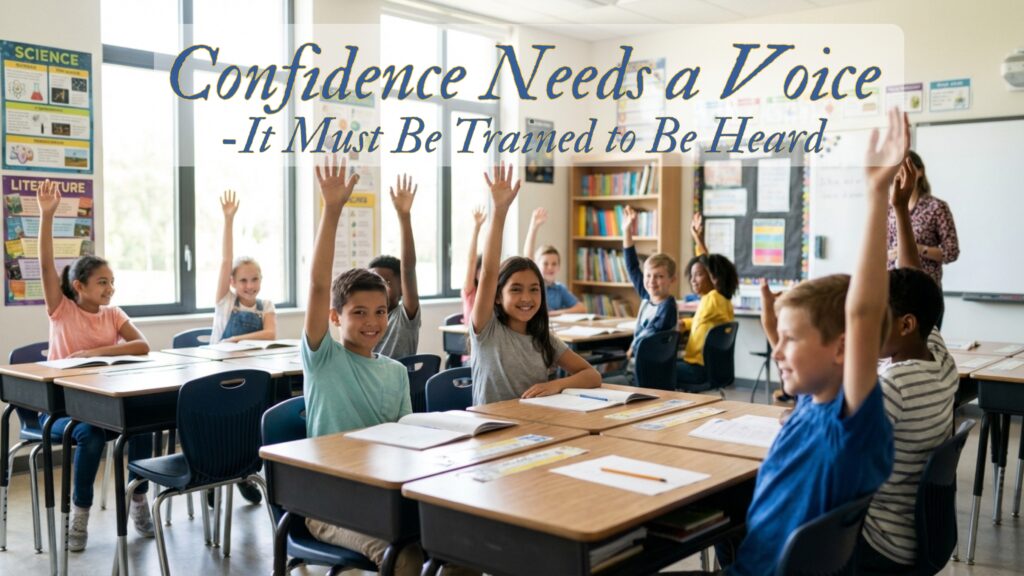
Part 2: Confidence Needs a Voice – It Must Be Trained to Be Heard
How structure builds real confidence through predictable success.

Part 3: Develop Confidence That Survives
The drill that exposes the difference between surface confidence and the real thing.